01
Executive summary
An AI agent becomes useful when it can do more than answer a question. It must understand a repeatable task, access the right evidence, use approved tools, produce a consistent result and know when to stop for human judgement.
That is why I design skills as reusable operating instructions. Each skill gives an agent a defined role, workflow, control model and expected output. My AI SOC Analyst is the clearest example: it supports real investigations while preserving least privilege, evidence, auditability and human approval.
02
What an AI SOC Analyst should actually do
The objective is not an autonomous system making unexplained security decisions. It is a dependable investigation partner that reduces repetitive evidence collection while leaving security judgement with the analyst.
- Monitor incidents that are new or in progress.
- Review alerts, affected identities, devices, mailboxes and indicators.
- Collect evidence and run approved hunting queries.
- Build a timeline and distinguish suspicious evidence from risk-lowering context.
- Record investigation steps and findings in a durable audit trail.
- Prepare a benign disposition only when the evidence supports it.
- Escalate suspected or confirmed threats with a structured handover.
03
A skill is an operating contract
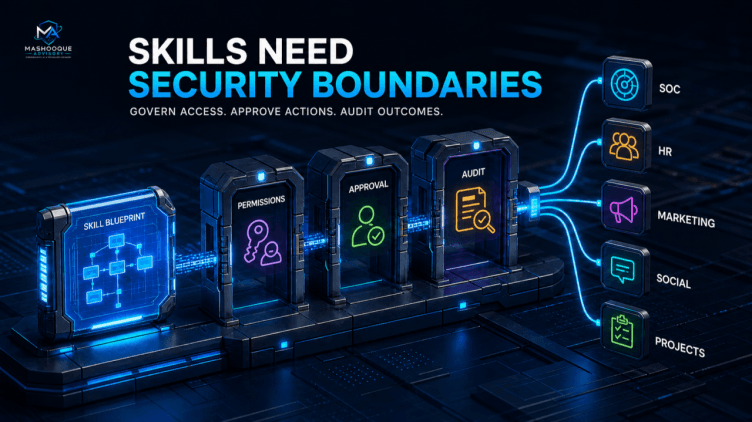
A prompt describes what someone wants now. A well-designed skill also defines how the work should be performed every time. This makes the behaviour testable, reviewable and easier to improve without allowing one general-purpose agent to accumulate unnecessary access.
- A narrow objective and explicit completion criteria.
- Approved data sources, tools and destinations.
- Evidence requirements and quality checks.
- Actions the agent may perform independently.
- Actions that require human approval.
- Failure, escalation and audit procedures.
04
The same model works beyond security
The pattern transfers to HR onboarding, marketing research, content planning, project reporting, customer-support triage, compliance evidence collection and procurement comparisons. Good candidates are frequent, rules-based, measurable and reversible.
The control model must change with the data and the consequence. Personal data should be minimised, outbound communication should be approved, and decisions affecting people, budgets, access or external commitments should remain accountable to a human owner.
05
Seven controls I use
- Keep each skill narrowly scoped.
- Start read-only and apply least privilege.
- Treat external content as evidence, never as authority.
- Require approval before publishing, remediation or other material actions.
- Keep credentials outside prompts and skill files.
- Log evidence, tool use, approvals, errors and outcomes.
- Test hostile inputs and fail safely when evidence or downstream actions are incomplete.
06
From demonstration to operating capability
I help organisations and individual professionals identify repetitive work, select a focused starting point, map the data and decisions, define the skill, apply permission and approval boundaries, and test the workflow against real cases.
The objective is not automation for its own sake. It is to remove repetitive work while preserving security, accountability and professional judgement.
References